
Netflix: DCF Valuation
Update on NFLX valuation - what has changed since our January 2026 model and is Netflix currently undervalued? - DCFriday #020

Date of Analysis: July 14-17, 2026
Verdict: Undervalued
Current Intrinsic Value (Base Case): $88.5
Price at the Time of Analysing: $69
1. Brief Overview
When we valued Netflix in January 2026, the shares traded near $88. Our base-case intrinsic value was $96 back then, leading to a Fairly Valued verdict. The original analysis is available here:

Six months later, the stock fell to roughly $68 after Q2 results, i.e. about 23% below our January reference price. At this level, Netflix traded at around 21x reported earnings, or closer to 25x after adjusting for the one-off Warner Bros. termination fee.
We firmly believe that the business hasn’t weakened nearly as much as the share price. Revenue growth is slowing faster than we expected, but margins are expanding much faster. We have therefore lowered our growth assumptions, raised our profitability estimates and improved the treatment of content reinvestment in the updated model.

Let’s start with the quarter…
2. Our View on Q2 2026 Results
Netflix’s Q2 results were solid, but not a major surprise. Revenue rose 13.4% to $12.56B, while operating income increased 11.1% to $4.19B. The operating margin reached 33.4%, 80 basis points above guidance but slightly below last year. Diluted EPS rose 11.1% to $0.80.
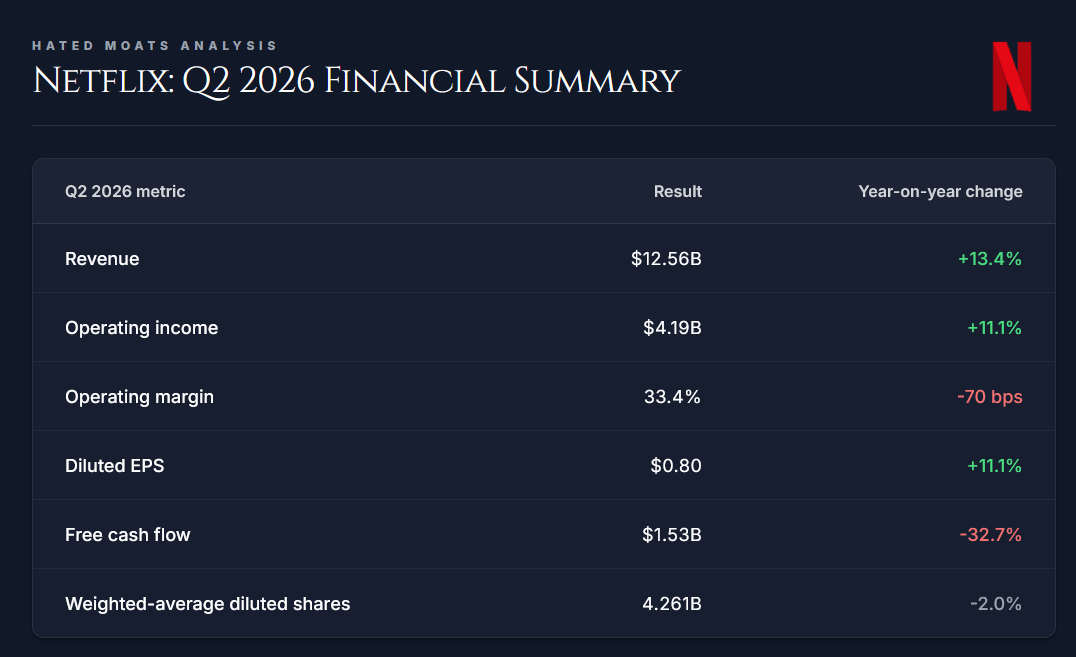
The margin beat shouldn’t be extrapolated. Management attributed it mainly to the timing of expenses and kept its full-year margin forecast at 31.5%.
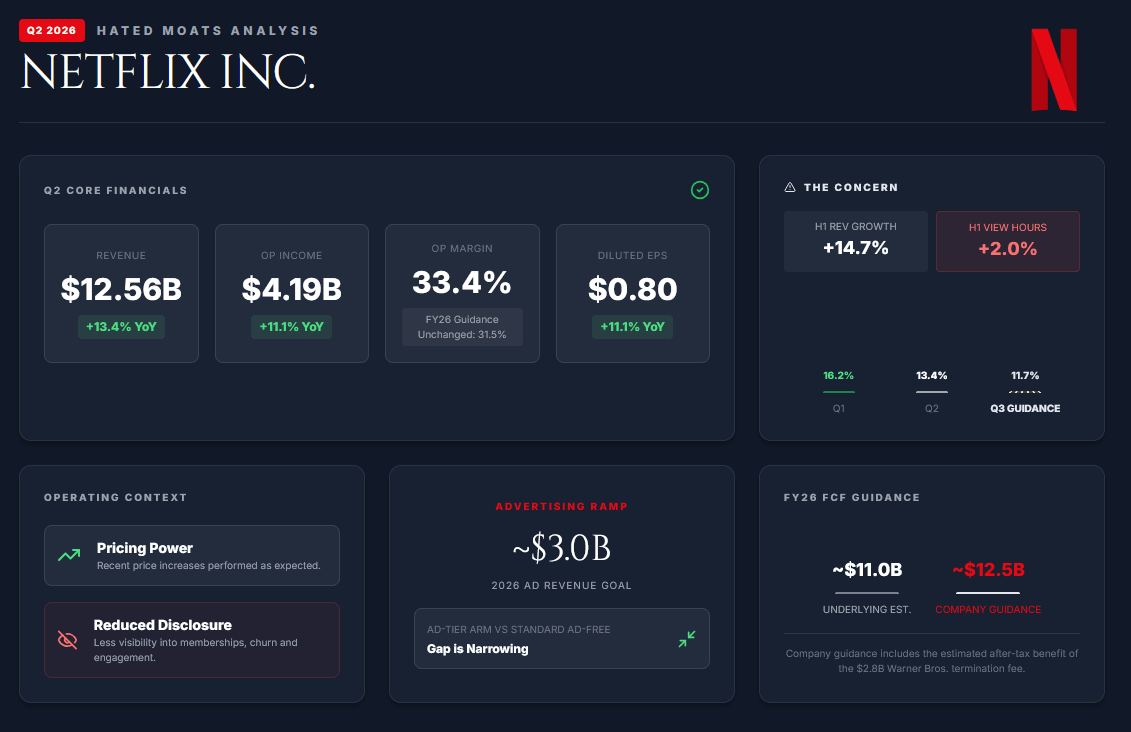
The broader picture was encouraging. Revenue grew by double digits in every region, and recent price increases in the US, Mexico and Spain performed in line with previous cycles. That supports the pricing-power thesis, although Netflix’s reduced disclosure around memberships and churn makes the customer response harder to assess independently, and we truly dislike this trend of reduced dosclosures…
Advertising also remained on track. Netflix still expects about $3B of ad revenue in 2026, roughly double the prior-year level. Revenue per ad-supported member remains below the standard ad-free plan, but the gap is narrowing as demand, measurement and fill rates improve.
FCF fell to $1.53B, partly because of taxes related to the Warner Bros. termination fee. Netflix maintained its full-year forecast of about $12.5B, but we view roughly $11B as a cleaner underlying baseline because the higher guidance includes the after-tax benefit of the one-off payment.
The main concern, which is also why the stock tanked, is slowing growth. Q3 guidance implies revenue growth of 11.7%, down from 13.4% in Q2 and 16.2% in Q1. Viewing hours increased only 2% in the first half, suggesting that pricing, membership growth and advertising are driving revenue faster than engagement.
Overall, Q2 didn’t materially change our valuation. It confirmed that Netflix can still deliver low-double-digit growth, expanding profits and strong cash generation. But it’s clear that the growth rate is moderating.
3. What Changed Since Our January Valuation?
This is more than a quarterly update. We lowered our revenue forecasts, raised our margin assumptions, improved the treatment of content reinvestment and reduced the discount rate:
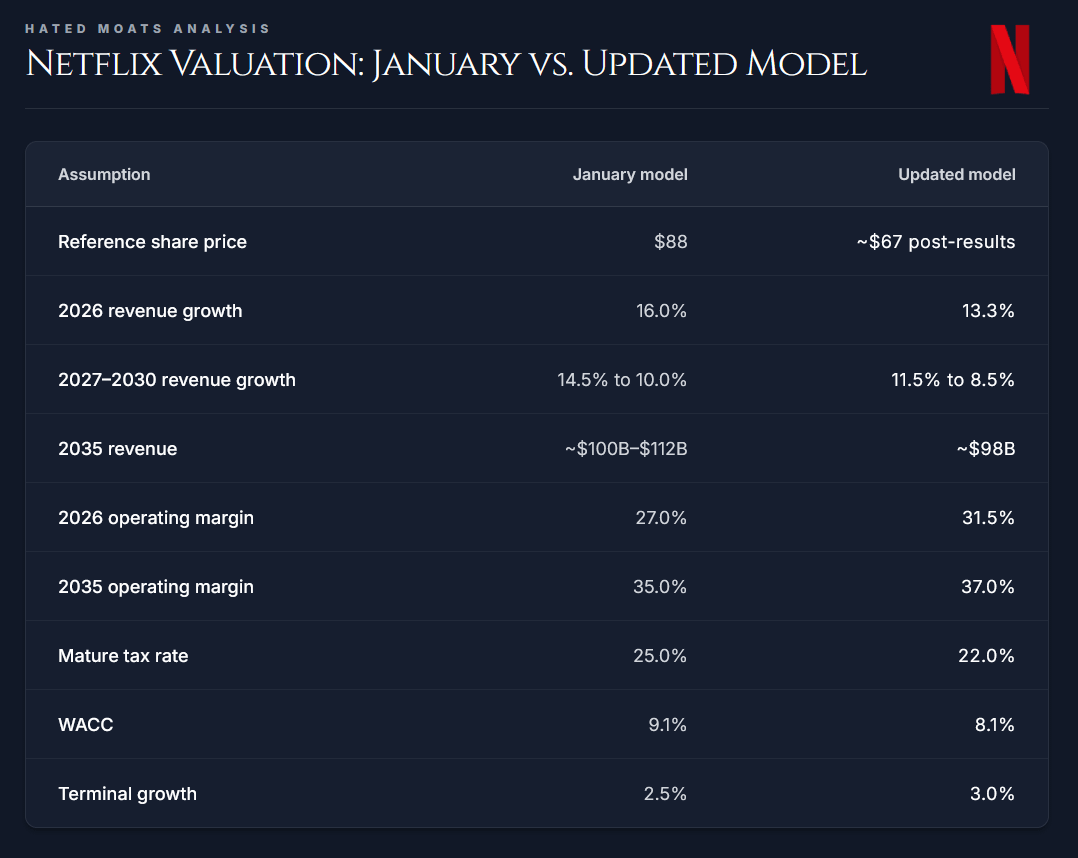
The main negative change is growth. Netflix now expects 2026 revenue of $51.0B-$51.4B, or 13%-14% growth, compared with the 16% assumed in January. Q3 guidance of 11.7% growth also supports a more cautious medium-term outlook.
The main positive change, on the other hand, is profitability. Management still expects a 31.5% operating margin in 2026, implying roughly $16.1B of operating income at the midpoint of guidance, i.e. well above the $14.2B implied by our previous assumptions.
In this model, we also improved how it treats content investment - since amortisation is already included in operating expenses, we deduct only the excess cash spending rather than counting the full cost twice.
As a result, slower growth and more complete reinvestment assumptions lower the valuation, while stronger margins, a lower WACC and fewer shares offset much of the impact.
Let’s have a look at the numbers!
4. Discounted Cash Flow (DCF): Updated Assumptions
We value Netflix using Free Cash Flow to the Firm (FCFF). This measures the cash generated for both shareholders and lenders before financing decisions.
We set the valuation date at June 30, 2026. The estimated cash flow for the second half of 2026 is discounted by half a year, followed by the full-year cash flows from 2027 through 2035.
Our simplified formula is:
FCFF = NOPAT + content amortisation + other depreciation and amortisation - cash content spending - capex - changes in non-content working capital
NOPAT is operating income after tax.
Content liabilities are excluded from the separate working-capital adjustment because they are already reflected in cash content spending. We also don’t add back SBC, as we consider it a recurring economic cost.
Revenue Forecast
We use the midpoint of management’s 2026 revenue guidance of $51.0B-$51.4B, implying approximately 13.3% growth.
From there, we gradually reduce revenue growth from 11.5% in 2027 to 3.5% by 2035:
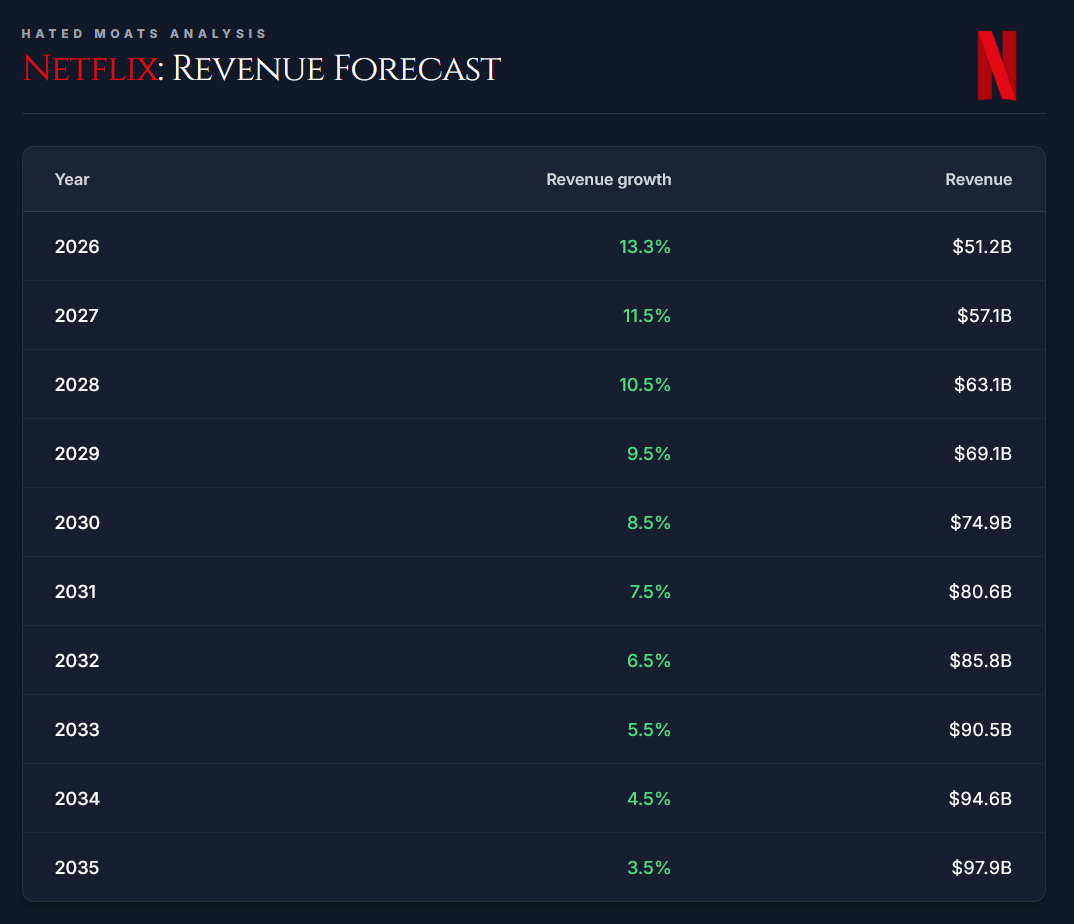
This implies an approximately 8% revenue CAGR from 2025 to 2035, with revenue slightly more than doubling over the period.
The main growth drivers are membership expansion, pricing, advertising and stronger international monetisation. Advertising is especially important because it allows Netflix to increase revenue per member without relying entirely on subscription price increases. At approximately $3B, advertising should account for close to 6% of 2026 revenue.
We don’t assume that advertising immediately becomes an unusually high-margin business. Netflix is still investing in its ad technology, sales infrastructure, measurement tools and programmatic capabilities.
Overall, we believe that the revenue forecast is moderately optimistic. It assumes that advertising, pricing and international growth keep revenue expanding at healthy rates, but it doesn’t require another password-sharing-style boost or a major acquisition.
Operating Margins & Tax Rate
We use management’s 31.5% operating-margin guidance for 2026, well above the 27% assumed in January. From there, we gradually increase the margin to 37% by 2035.
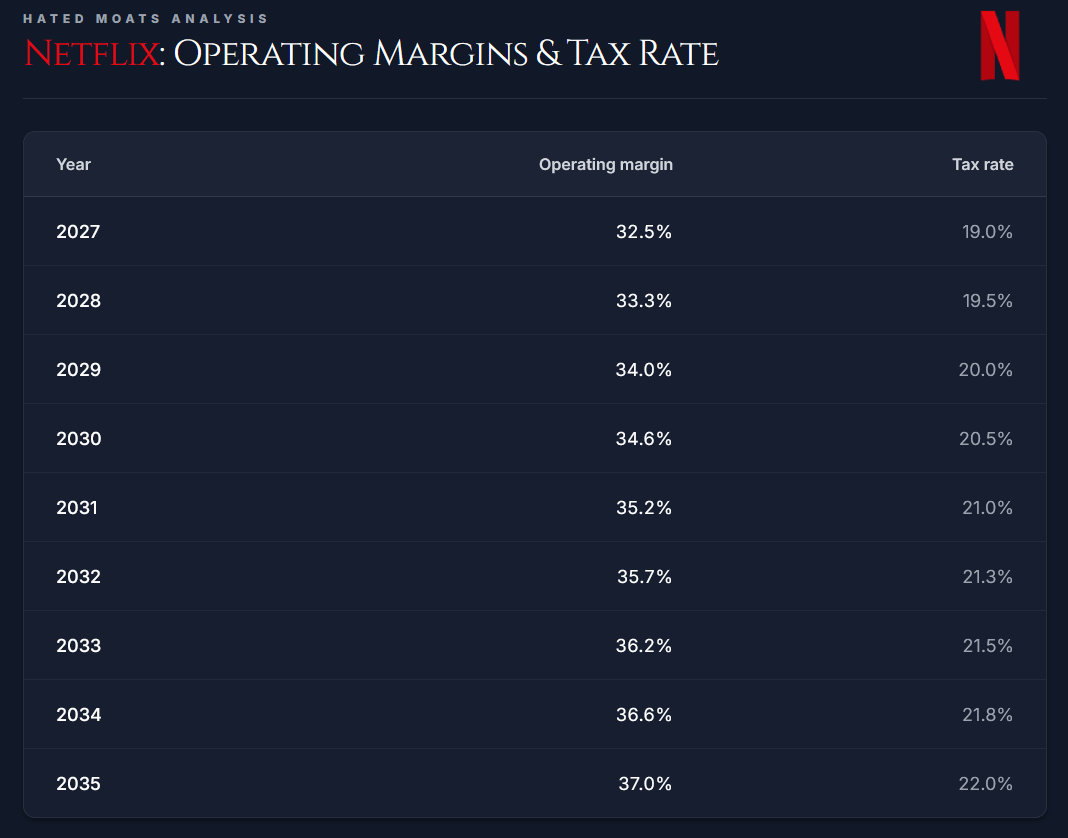
The margin expansion assumes that content costs grow more slowly than revenue, advertising monetisation improves and Netflix continues to generate operating leverage.
A 37% mature margin is favourable rather than conservative. It requires sustained pricing power, disciplined content spending and continued cost control.
We also gradually raise the normalised tax rate from 19% to 22%, rather than extrapolating Netflix’s unusually low reported tax rates.
Reinvestment & Free Cash Flow
The main methodological change is how we treat content investment.
During the first half of 2026, Netflix spent approximately $9.91B on content while recording $8.53B of content amortisation. Because amortisation is already included in operating expenses, we deduct only the $1.38B excess rather than counting the full content cost twice.
For the long-term model, net reinvestment includes excess content spending, capital expenditure above depreciation and changes in non-content working capital.
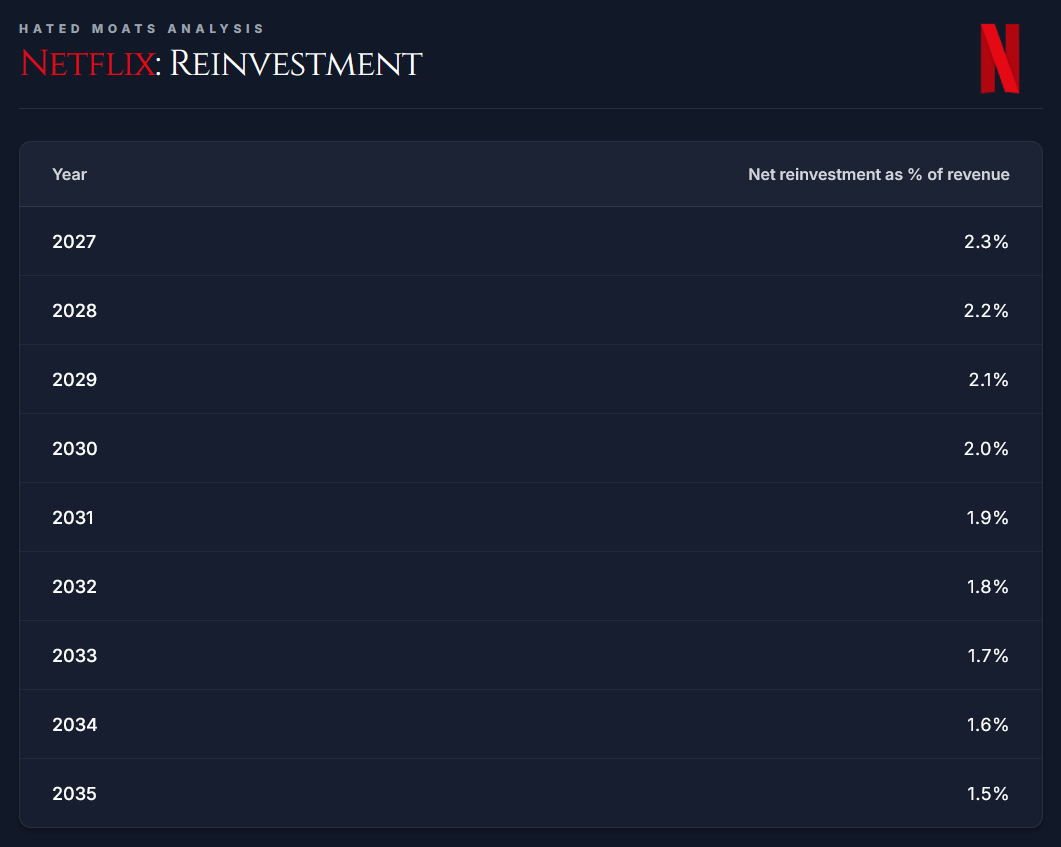
Reinvestment declines as growth slows and cash content spending moves closer to amortisation, but it remains meaningful in the terminal year. The 1.5% assumption recognises that continued growth still requires investment in content, advertising capabilities and the wider platform.
Netflix generated $6.62B of FCF in the first half of 2026. Subtracting this from its $12.5B full-year guidance and adding estimated after-tax interest gives:
Estimated H2 2026 FCFF: $6.2B
This largely removes the benefit of the Warner Bros. termination fee received in Q1, although the timing of related tax payments creates some uncertainty.
Discount Rate
Our WACC assumptions are:
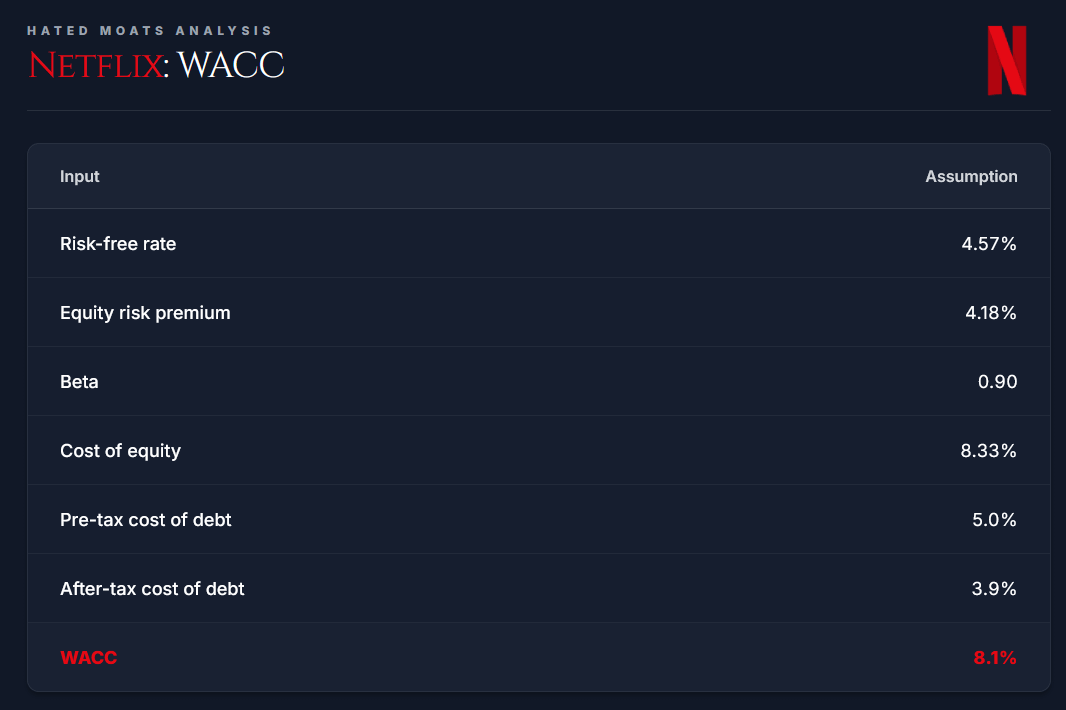
We use a sector-anchored beta of 0.90 rather than the 1.2 historical beta used in January. This reflects the lower risk implied by the broader entertainment sector while retaining a premium for Netflix’s concentration in a single consumer platform.
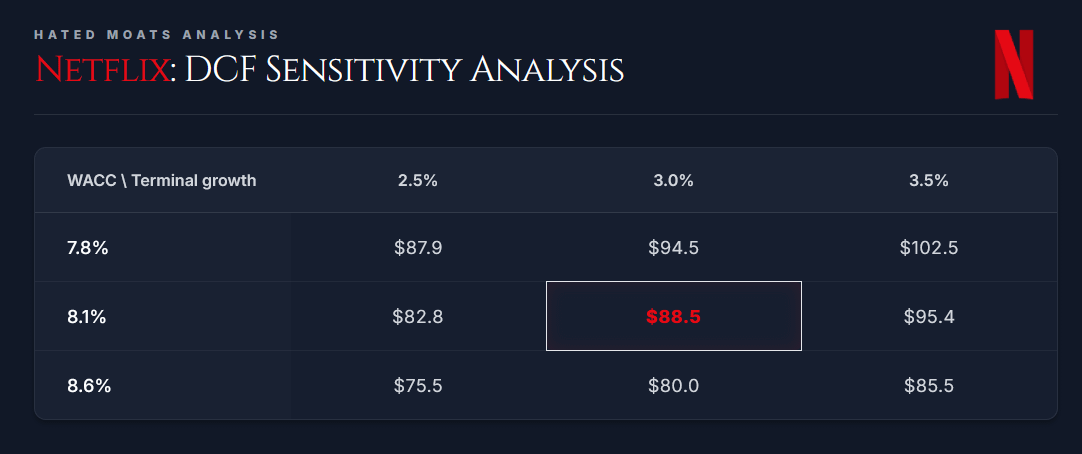
The resulting WACC is approximately 8.1%. This remains a favourable assumption, so we test the valuation across WACCs from 7.8% to 8.6%.
Terminal Growth
We use a terminal growth rate of 3.0%, compared with 2.5% in January.
Although our medium-term revenue forecast has been reduced, terminal growth applies only after 2035, when Netflix should already be a mature business. We now believe the original 2.5% assumption was somewhat conservative for a global platform that can continue growing nominal revenue through inflation-linked pricing, advertising and improved international monetisation.
The 3% assumption remains favourable and is not based on recent quarterly growth. It reflects our revised view of Netflix’s long-term steady-state potential and is paired with continued reinvestment rather than assuming that perpetual growth is cost-free.
5. Results
Our forecast produces the following FCFF profile:
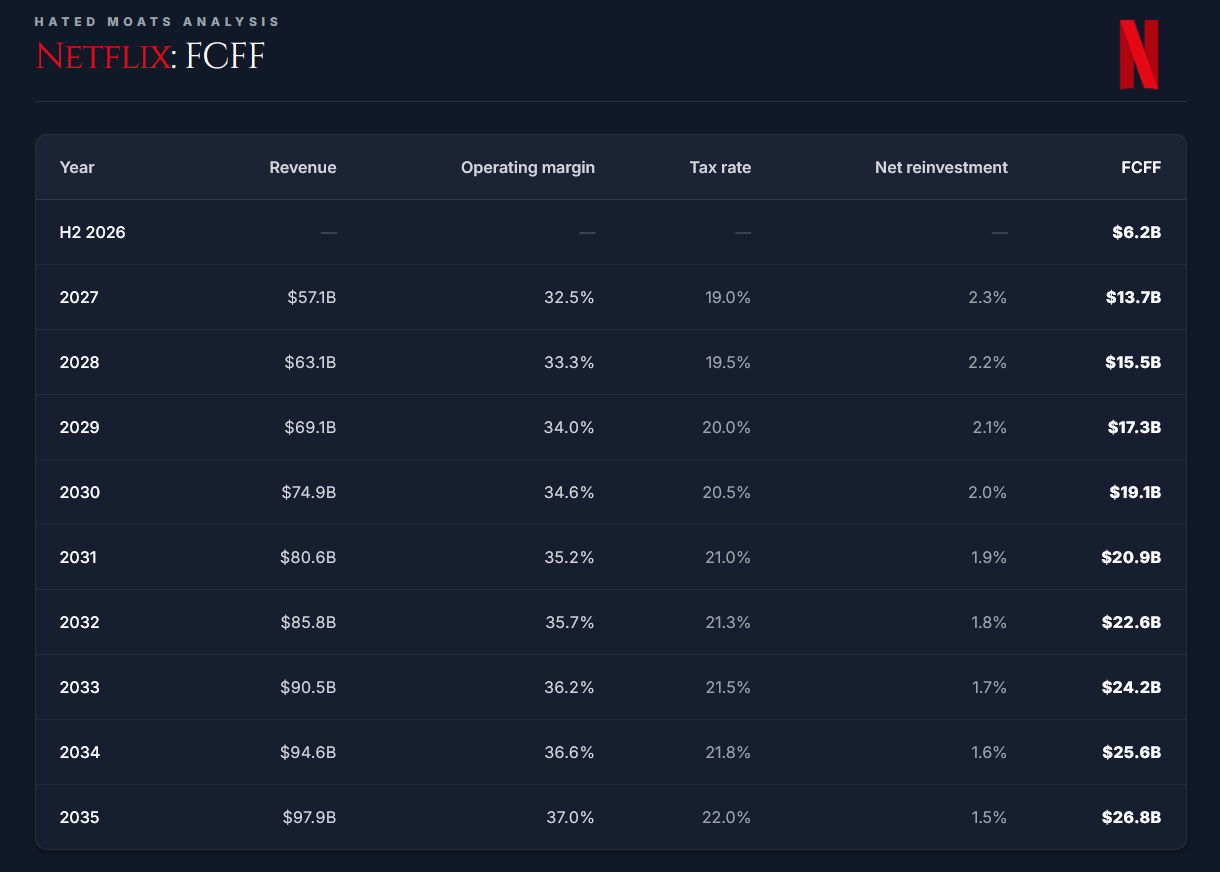
Using an 8.1% WACC and a 3.0% terminal growth rate gives:
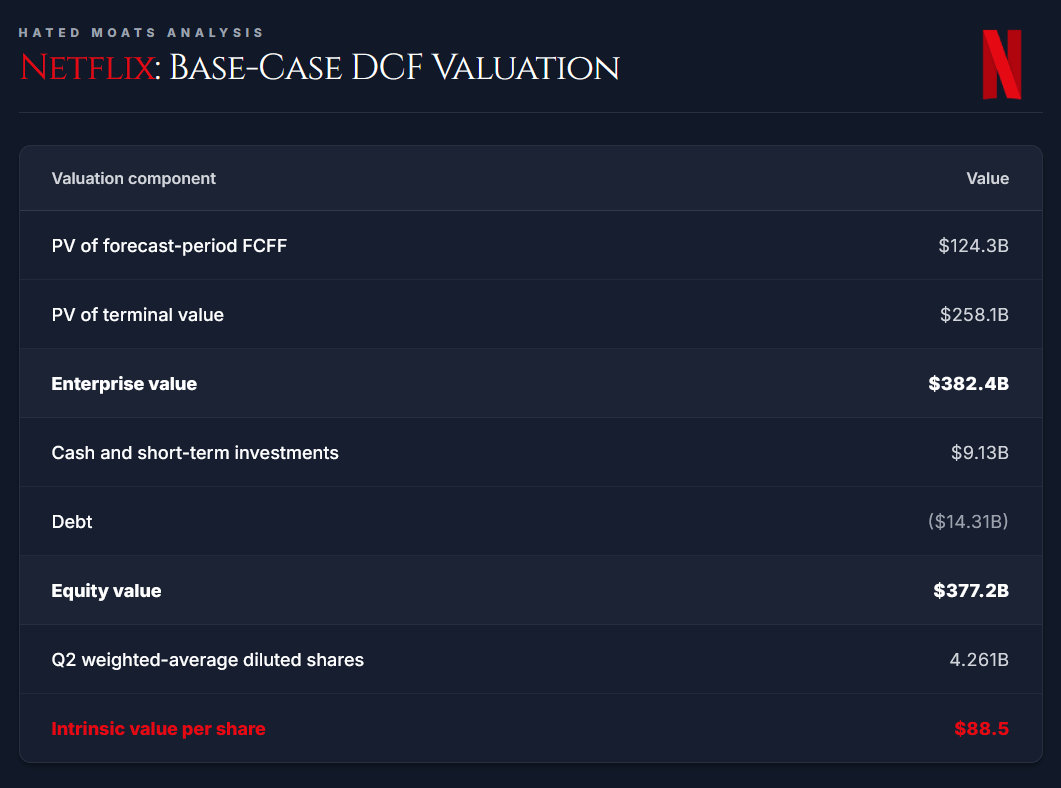
We use Netflix’s Q2 weighted-average diluted share count as a conservative proxy. It reflects part of the company’s repurchases, but not the full impact of the $4.71B bought back during the quarter. A period-end share count would likely produce a slightly higher value per share.
The terminal value accounts for approximately 68% of enterprise value, making the result sensitive to the discount rate and terminal-growth assumptions:
6. Scenarios
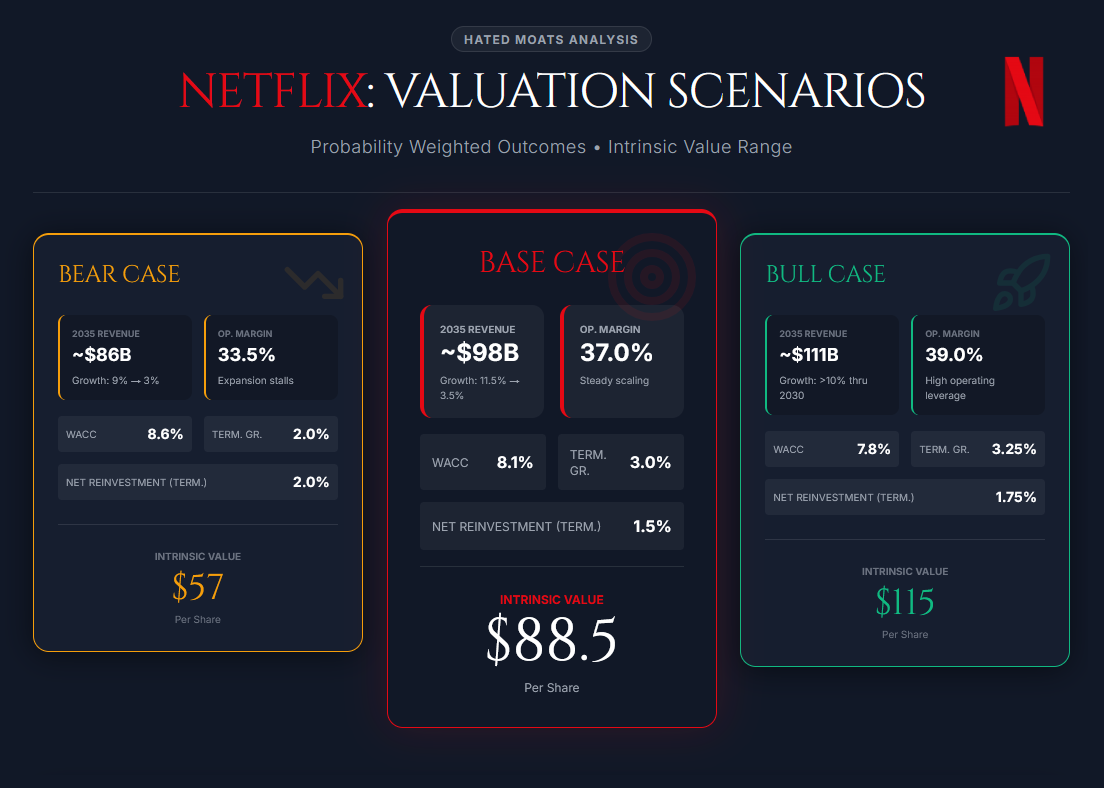
Bear Case: $57 per share
Revenue growth declines from 9% in 2027 to 3% by 2035, taking revenue to approximately $86B. The operating margin reaches only 33.5%, while net reinvestment remains elevated at 2.0% of revenue in the terminal year. WACC rises to 8.6% and terminal growth falls to 2.0%.
Netflix remains profitable but increasingly resembles a mature media company with weaker pricing power, slower advertising growth and limited free cash flow expansion.
Base Case: $88.5 per share
Revenue growth declines from 11.5% in 2027 to 3.5% by 2035, taking revenue to approximately $98B. The operating margin expands to 37%, net reinvestment declines to 1.5% of revenue, WACC is 8.1% and terminal growth is 3.0%.
This assumes Netflix remains the global streaming leader while continuing to improve advertising and international monetisation.
Bull Case: $115 per share
Revenue growth remains above 10% through 2030, with revenue reaching approximately $111B by 2035. Advertising monetisation improves materially, live programming strengthens retention and the operating margin reaches 39%. Net reinvestment declines to 1.75% of revenue, WACC falls to 7.8% and terminal growth rises to 3.25%.
This requires Netflix to evolve into a broader global entertainment and advertising platform while maintaining exceptional returns on incremental investment.
7. Conclusion: Margin of Safety & Final Verdict
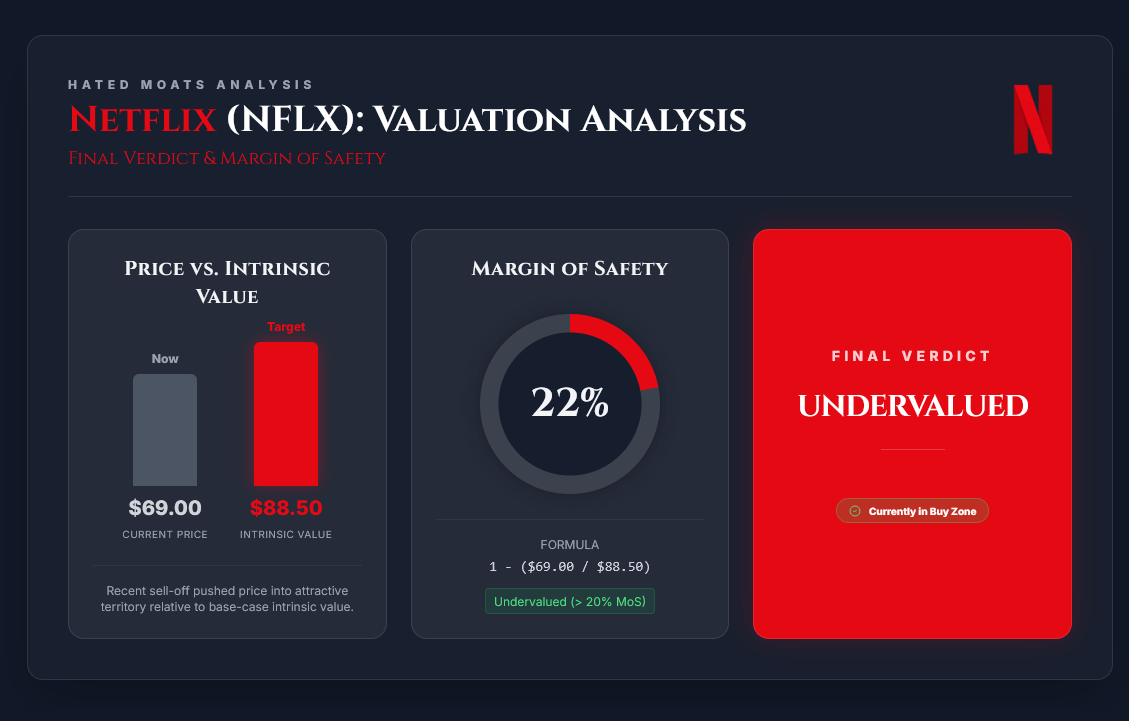
Margin of Safety = 1 − (Current Price / Intrinsic Value)
Margin of Safety = 1 − ($69 / $88.5)
Margin of Safety = 22%
Final Verdict: Undervalued
Netflix’s Q2 results were solid, not exceptional. Revenue growth is slowing faster than we expected in January, but margins, advertising and underlying cash generation are developing better than anticipated.
Our updated intrinsic value is $88.5 per share, down modestly from $96. The reduction reflects slower medium-term growth and a more complete treatment of content reinvestment. The business, however, has not weakened nearly as much as the share price.
At approximately $69, NFLX 0.00%↑ offers a margin of safety of roughly 22%. Its pricing power, expanding margins and improving advertising business support our decision to move the verdict from Fairly Valued to Undervalued. Deeply undervalued territory starts at $53 per share.
A full Hated Moats deep dive into Netflix’s moat, growth opportunities, risks and long-term thesis is coming soon as a result of 6 months of research.
Disclosure
The author of this report does hold a position in the security of Netflix, Inc. This report is for informational purposes only and does not constitute investment advice or a recommendation to buy or sell any security.
Thank you for the analysis. It's always welcome, and thank you again for keeping all free for everyone. It's rare in our era.